
Meghalaya travel guide 2026: crystal-clear Dawki boat rides, the Double Decker Root Bridge, Cherrapunji's waterfalls, and Asia's cleanest village, Mawlynnong.
Tucked into India's Northeast, Meghalaya is a state built almost entirely out of superlatives — the wettest place on earth, living bridges grown from tree roots, and a village so tidy it's been called Asia's cleanest. If you're planning a Meghalaya tour package for 2026, this guide walks through every stop worth building your itinerary around, from the misty streets of Shillong to the turquoise waters of the Umngot river at Dawki.
Shillong — Where Every Meghalaya Trip Begins
Most journeys into Meghalaya start in Shillong, the state capital perched at nearly 5,000 feet and nicknamed the 'Scotland of the East' for its rolling hills and cool climate. It's less a single attraction than a base to settle into — wander Police Bazar's lanes for local shawls and street food, sip coffee at a hillside café overlooking the valley, and let the town's unhurried pace set the tone for the rest of the trip.
Just outside the city, Umiam Lake (locally called Barapani) is usually the first proper stop for anyone driving in from Guwahati airport — a vast reservoir ringed by pine-covered hills, calm enough for kayaking or a slow pedal-boat ride, and a good excuse to stretch your legs before Shillong's evening market crowds.

Want a ready-made Meghalaya itinerary?
Tell us a few details — we'll send free pricing and dates.
Elephant Falls
A short drive from central Shillong, Elephant Falls drops across three distinct tiers through a narrow gorge, reached via a short flight of stone steps that makes it one of the easiest waterfalls in Meghalaya to fit into a half-day city loop. It isn't the tallest or most dramatic fall on this list, but its convenience — and the moss-covered rock formations along the descent — make it a solid first taste of what's waiting further down the itinerary.

Laitlum Canyon
About 25 kilometres from Shillong, Laitlum Canyon (the name roughly translates to 'end of hills') opens up without warning — one moment you're driving through a quiet village, the next you're standing at the edge of a sheer drop into a canyon carpeted in green, with the Sohpetbneng peak visible on a clear day. It's one of the least crowded viewpoints on this route and among the best sunset spots in the East Khasi Hills, especially if you time your Shillong-to-Cherrapunji drive to pass through in the late afternoon.

Cherrapunji — Waterfalls, Caves and Record-Breaking Rainfall
Cherrapunji (officially Sohra) held the record for the wettest place on earth for decades, and even outside monsoon season its landscape carries that history — deep gorges, sheer cliffs, and waterfalls that seem to appear around every bend. It's usually the second base of a Shillong Cherrapunji Dawki itinerary, and easily deserves a full day on its own.
Nohkalikai Falls
At around 340 metres, Nohkalikai is India's tallest plunge waterfall, and the viewpoint across the gorge puts you at eye level with the full drop — a single, uninterrupted column of water crashing into a pool that turns a startling shade of blue-green in clear weather. Go early morning if you can; cloud cover rolls in by midday during much of the year and can hide the base of the falls entirely.

Seven Sisters Falls
Locally known as Nohsngithiang, the Seven Sisters Falls is a set of seven parallel streams that tumble off the same limestone cliff face, at their most spectacular in the days right after monsoon rain when every strand is running full. The main viewpoint sits just off the road, making it an easy add to the same loop as Nohkalikai without extra driving.

Mawsmai Cave
For a break from waterfalls, Mawsmai Cave offers a short, well-lit walk through limestone passages near Cherrapunji town — narrow enough in places that you'll duck and squeeze through, but the whole loop takes well under an hour, making it an easy stop between the falls and lunch.

The Living Root Bridges — Meghalaya's Most Famous Attraction
Nowhere else in the world do bridges grow. Over generations, the War-Khasi and War-Jaintia communities of southern Meghalaya have trained the roots of rubber fig trees across rivers and gorges, guiding them along bamboo scaffolding until they fuse into bridges strong enough to carry foot traffic — some over a century old and still growing stronger.
Double Decker Root Bridge & the Nongriat Trek
The most famous of these, the Double Decker Root Bridge near Nongriat village, is reached by descending roughly 3,500 stone steps from Tyrna village — a genuine trek rather than a casual walk, but one that rewards you with a bridge stacked two levels high over a jungle stream, plus the chance to swim in nearby natural pools before the climb back up. Budget the better part of a day for this one, and start early to avoid the midday heat on the return climb.

Mawlynnong — Asia's Cleanest Village
Mawlynnong earned its reputation as Asia's cleanest village the old-fashioned way: community-enforced cleanliness drives, bamboo dustbins on every corner, and a culture of upkeep passed down through generations. Beyond the tidy lanes, it's also home to a Single Decker Root Bridge and a Sky View treehouse platform with sweeping views into Bangladesh on a clear day, plus a giant Balancing Rock a short walk from the village centre.

Dawki River — Boating on the Umngot
Few rivers anywhere are as clear as the Umngot at Dawki, where the water is transparent enough that boats appear to float mid-air over their own shadows on the riverbed. A short boat ride here — usually a wooden canoe paddled out by a local boatman — has become one of the most photographed experiences in Meghalaya, and for good reason; even in photos it's hard to tell where the water ends and the air begins.

Shnongpdeng — Suspension Bridge, Camping and River Adventure
A short drive from Dawki, Shnongpdeng sits on the same Umngot river but trades the boat-ride crowds for a quieter riverside camp scene — tents pitched right on the sandy banks, a long suspension bridge for river-crossing photos, and optional adventure add-ons like kayaking, cliff jumping, and scuba diving in season. It's the natural place to end a Dawki day if you'd rather camp by the water than drive straight back to Shillong.

Krang Suri Falls — Meghalaya's Best-Kept Secret
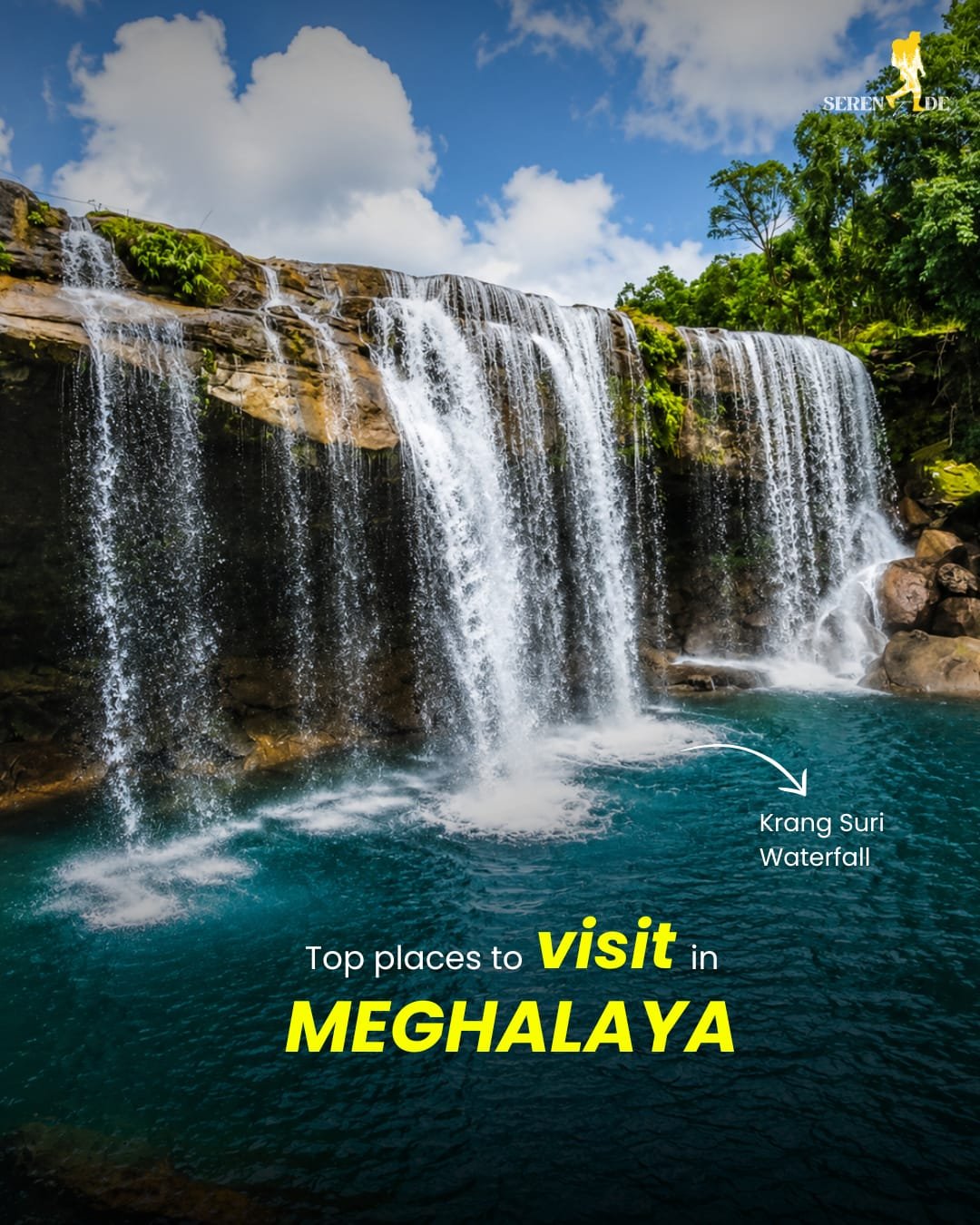
Tucked near Jowai in the Jaintia Hills, Krang Suri Falls sees a fraction of the footfall that Cherrapunji's waterfalls do, largely because it sits slightly off the standard Shillong-Cherrapunji-Dawki route. The reward for the detour is a turquoise plunge pool perfect for a swim, framed by a curtain of falling water — genuinely one of the most photogenic and least crowded stops on this entire list.

Best Time to Visit Meghalaya
- October to April — the most reliable window for sightseeing, with clearer skies, drier trails, and full visibility at viewpoints like Laitlum Canyon and Nohkalikai Falls.
- June to September — monsoon season; waterfalls are at their most powerful (especially the Seven Sisters), though road visibility and trekking conditions get tougher.
- November to February — the coolest, driest stretch, ideal for the Nongriat trek and river activities at Dawki and Shnongpdeng.
A Sample Shillong Cherrapunji Dawki Itinerary
If you're mapping this out yourself, most of the stops above fall naturally into a five- to six-night loop out of Guwahati: Shillong and Umiam Lake first, Cherrapunji's falls and caves next, the Nongriat root bridge trek on day three, then Mawlynnong and Dawki before heading back. It's more or less the structure behind Serenade's Meghalaya group tour from Guwahati, and it's also how we've built out our longer Meghalaya with Kaziranga package for travellers who want to add a wildlife safari onto the same trip.
If a fixed-departure Meghalaya group trip works better for you than planning every stop solo, check out our Meghalaya tour packages — they cover everything on this list with stays, transport, and a trek guide included — or go straight to our 6N/7D Meghalaya with Kaziranga trip if you want to add a wildlife safari to the circuit.
Ready to Experience It?
Explore Meghalaya
Join a group departure with Serenade Travels — all logistics handled, experienced trip leader included.
View 5N/6D Meghalaya Trip →Ready to Experience It?
Meghalaya Adventure with Kaziranga
Join a group departure with Serenade Travels — all logistics handled, experienced trip leader included.
View 6N/7D Meghalaya + Kaziranga Trip →Final Thoughts
Meghalaya rewards travellers willing to trade a bit of comfort for genuine surprise — a bridge grown instead of built, a river you can see through, a waterfall record older than the country itself. Whichever combination of these stops makes it into your 2026 itinerary, give yourself enough days to actually sit with each place instead of rushing between photo stops.